
WordPress 5.0 introduced the block editor; 4.9.4 fixed an automatic-update failure; 5.3.2 corrected a handful of maintenance problems. All were updates, but they answered very different needs. Knowing which one an old article refers to is more useful than treating every “update available” headline as interchangeable.
This guide brings together 28 versions mentioned in the retrieved Systm Web archive, from April 2016 to December 2019. It is a selected historical directory, not a complete list of every release in that period and not a recommendation to install these old versions. Dates and release classifications have been checked against WordPress.org.
Three dates that should not be confused
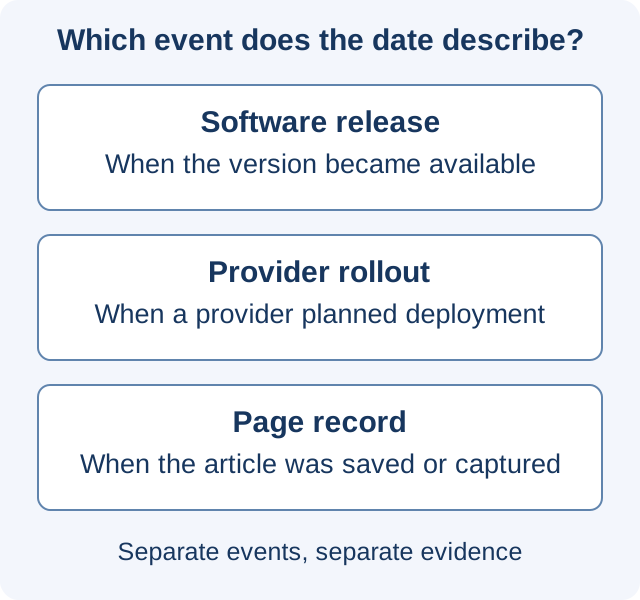
A software release date tells you when that version became available. A provider’s rollout date tells you when it intended to deploy the update to its own customers. An article’s publication, revision or archive-capture date describes the page. These events can occur days, months or years apart.
For example, a December customer notice discussing a February rollout does not make February the software’s release month. The entries below use the WordPress release date. They make no claim about when a particular former Systm Web customer was updated.
Browse 2016, 2017, 2018 or 2019. Each version has its own link to the official announcement. The notes summarize selected changes; consult that announcement for the full scope and qualifications.
2016
WordPress 4.5: Feature release: Coleman
April 12, 2016. Inline link editing and responsive previews in the Customizer made writing and previewing a site less disruptive. Theme support for custom logos also arrived. These changes belong to the pre-block-editor workflow; they should not be confused with the editor introduced in 5.0. Official 4.5 announcement.
WordPress 4.5.1: Maintenance
April 26, 2016. The follow-up addressed 12 bugs, including a Twenty Eleven theme problem, a Chrome/visual-editor incompatibility and an Imagick issue affecting uploads. It illustrates why a maintenance release can matter even when it adds no prominent new feature. Official 4.5.1 announcement.
WordPress 4.5.2: Security
May 6, 2016. The announcement concerned vulnerabilities in the bundled Plupload and MediaElement.js libraries, used for uploads and media playback. It was a security update, rather than a change to the publishing workflow described in the 4.5 feature announcement. Official 4.5.2 announcement.
WordPress 4.6: Feature release: Pepper
August 16, 2016. Plugin and theme installation, updates and deletion could happen without leaving the current administration page. The dashboard adopted native system fonts, while editing changes included link checking and browser-based content recovery. These were several separate improvements, not one performance guarantee. Official 4.6 announcement.
WordPress 4.7: Feature release: Vaughan
December 6, 2016. Twenty Seventeen arrived with a business-oriented front page, while the Customizer gained additional setup tools and custom CSS editing. The release also introduced REST API content endpoints. That API change helps explain why access and permissions appear in later maintenance and security notices. Official 4.7 announcement.
2017
WordPress 4.7.1: Security and maintenance
January 11, 2017. The release combined security changes with 62 bug fixes. Among the documented security changes were narrower REST API exposure of author data and fixes involving widget editing. The official announcement also carefully distinguished a precautionary PHPMailer update from a demonstrated issue in WordPress itself. Official 4.7.1 announcement.
WordPress 4.7.2: Security
January 26, 2017. The official notice covers permission checks, query hardening, a posts-list issue and a REST API privilege-escalation vulnerability. For the query issue it explicitly distinguishes unsafe use by extensions from a directly vulnerable core installation. Preserve that qualification when interpreting old security headlines. Official 4.7.2 announcement.
WordPress 4.7.4: Maintenance
April 20, 2017. Its 47 fixes and enhancements included visual-editor compatibility with an upcoming Chrome version, media-handling consistency and REST API improvements. A browser change and a server-side application change can interact; the release note records which compatibility problem was being addressed at that time. Official 4.7.4 announcement.
WordPress 4.7.5: Security and maintenance
May 16, 2017. Six security issues were addressed alongside three maintenance fixes. The security work included redirect validation, XML-RPC metadata handling and capability checks. Although the announcement opens by emphasizing security, its full title and contents also identify the maintenance component. Official 4.7.5 announcement.
WordPress 4.8: Feature release: Evans
June 8, 2017. Image, audio and video widgets joined an improved text widget with visual editing. The release also changed link-boundary behavior in the editor and displayed nearby WordPress events in the dashboard. It expanded everyday publishing controls without introducing the later block editor. Official 4.8 announcement.
WordPress 4.8.2: Security and maintenance
September 19, 2017. The update addressed several security issues and included six maintenance fixes. Query preparation received hardening, alongside fixes concerning the editor, redirects and archive extraction. The announcement’s caveat about WordPress core not being directly vulnerable to the query issue remains part of the historical record. Official 4.8.2 announcement.
WordPress 4.8.3: Security
October 31, 2017. This release revisited query preparation and changed the behavior of esc_sql(). Its announcement linked a separate developer note explaining that change. An old reference to this version may therefore concern extension compatibility as well as the security motivation for the release. Official 4.8.3 announcement.
WordPress 4.9: Feature release: Tipton
November 16, 2017. Customizer changes could be drafted, scheduled, shared through preview links and protected with design locking. Code-editing checks and a Gallery widget were other additions. The scheduling feature here concerns design changes, which is distinct from scheduling an individual article for publication. Official 4.9 announcement.
2018
WordPress 4.9.2: Security and maintenance
January 16, 2018. WordPress removed affected Flash fallback files from its bundled MediaElement player and included maintenance fixes. This was a specific response to a media-library vulnerability, not a general instruction to remove arbitrary files from a present-day installation. Official 4.9.2 announcement.
WordPress 4.9.3: Maintenance
February 5, 2018. The announcement listed 34 fixes covering areas such as Customizer changesets, widgets, the visual editor and PHP 7.2 compatibility. The release subsequently required the next day’s 4.9.4 correction. Read the two entries together when reconstructing an update incident from February 2018. Official 4.9.3 announcement.
WordPress 4.9.4: Maintenance: automatic-update correction
February 6, 2018. Version 4.9.3 had introduced a bug that prevented affected installations from completing automatic background updates. The 4.9.4 notice explained that intervention through the dashboard or a host’s tools was needed. This is a concrete historical example of why an enabled update setting is not proof of a successful update. Official 4.9.4 announcement.
WordPress 4.9.5: Security and maintenance
April 3, 2018. The security changes concerned localhost handling, redirects from an SSL-enforced login page and escaping the version string in generator tags. An old reference to the generator-tag change concerns how the value was escaped, rather than a new feature for hiding the WordPress version. Official 4.9.5 announcement.
WordPress 4.9.6: Privacy and maintenance
May 17, 2018. The release added tools for designating a privacy-policy page, exporting personal data and handling erasure requests, with participation by compatible plugins. It also changed the commenter-cookie choice. These were software capabilities; their presence alone was not evidence that a particular site’s data handling complied with every applicable obligation. Official 4.9.6 announcement.
WordPress 5.0: Feature release: Bebo
December 6, 2018. The block editor and Twenty Nineteen theme marked a major change in the editing experience. WordPress released 5.0 on December 6, 2018. A hosting provider’s later rollout or customer deadline is a separate event and should not replace that release date in a historical timeline. Official 5.0 announcement.
2019
WordPress 5.1.1: Security and maintenance
March 13, 2019. Comment filtering and storage were changed to address cross-site scripting issues. Other work helped hosts prepare users for the PHP requirement change planned for 5.2. The announcement’s future-looking PHP discussion belongs to that 2019 transition, not to today’s platform requirements. Official 5.1.1 announcement.
WordPress 5.2: Feature release: Jaco
May 7, 2019. Site Health gained pages for configuration checks and debugging information, building on work in 5.1. Recovery mode offered a way to manage certain fatal errors by pausing the responsible plugin or theme. These tools supported investigation; they did not make a separate recovery plan unnecessary. Official 5.2 announcement.
WordPress 5.2.1: Maintenance
May 21, 2019. The 33 fixes included work on the block editor, accessibility, internationalization and Site Health. This was a follow-up to 5.2. The Site Health work should be understood as refinement of the feature, rather than its first appearance in WordPress. Official 5.2.1 announcement.
WordPress 5.2.2: Maintenance
June 18, 2019. The announcement recorded 13 bug fixes and further Site Health refinements. It identified 5.3 as the next major release. The later 5.2.3 and 5.2.4 entries below were further updates within the 5.2 branch, with security changes included in their scope. Official 5.2.2 announcement.
WordPress 5.2.3: Security and maintenance
September 5, 2019. Security fixes covered several cross-site scripting paths and a redirect issue, alongside maintenance work. The release also brought a jQuery change to older branches. A historical audit should identify the branch actually installed, rather than assume every site moved to the same version. Official 5.2.3 announcement.
WordPress 5.2.4: Security
October 14, 2019. The six listed security issues included problems involving the Customizer, style tags, request validation and JSON-response caching. The announcement also described updates for older branches. This entry identifies the release and its purpose; it does not establish whether any individual site installed it. Official 5.2.4 announcement.
WordPress 5.3: Feature release: Kirk
November 12, 2019. The block editor gained further layout controls, including the Group block, and the Twenty Twenty theme was introduced. Improvements also covered large-image handling, image rotation and Site Health. These were distinct changes within one release, rather than evidence that every theme adopted the same layout. Official 5.3 announcement.
WordPress 5.3.1: Security and maintenance
December 12, 2019. Security fixes accompanied work on administration controls, editing, dates, uploads and other areas. The upload changes included avoiding certain thumbnail filename collisions. This entry is useful beside 5.3.2, which followed with further corrections rather than a new feature release. Official 5.3.1 announcement.
WordPress 5.3.2: Maintenance
December 18, 2019. The official release contained five fixes and enhancements involving dates, uploads, media warnings, button colors and post-status handling. An old Systm Web headline called it a security and maintenance release. The classification here follows the official announcement: maintenance. Official 5.3.2 announcement.
Using this history in a site investigation
Imagine an old support ticket saying that automatic updates were enabled in early February 2018. That setting alone would not tell you whether the site passed through the 4.9.3 failure and received 4.9.4. You would need a record of the version actually installed, or other evidence of the completed update. This is an illustrative investigation, not a report about a former customer.
Use the same distinction for security notices: a published fix, a host’s announcement and a verified installation are separate pieces of evidence. A release title cannot prove that a particular site was protected, nor that its unrelated themes and plugins were current.
For work on a live site today, start with its current environment and the maintenance checklist. If the investigation involves moving the installation, use the migration plan. Historical version notes help explain a record; they do not replace a current upgrade and recovery plan.
Compiled November 16, 2026. The selection follows version notices found in retrieved Systm Web pages and their menus. Some original article bodies were unavailable; all release summaries above were newly written from the linked official announcements. Dates were cross-checked against the WordPress release archive. This is neither a full release history nor a record of customer installations.